
Guo Guangcan, CAS Academician & USTC Professor: Four Decades Chasing Quantum "Light"
source:People's Daily
keywords:
Time:2025-11-04
Source: People's Daily 14th Oct 2025
Brief Biography
Guo Guangcan, born in 1942 in Quanzhou, Fujian Province, is an Academician of the Chinese Academy of Sciences (CAS) and Professor at the University of Science and Technology of China (USTC). He is one of the pioneers of quantum optics and quantum information science in China.
Devoting long-term efforts to teaching and research in quantum optics and quantum information, he was the first to introduce the theoretical system of quantum optics to China, driving the development of quantum information science in the country. His honors include the Second Class National Natural Science Award and the Ho Leung Ho Lee Foundation Science and Technology Progress Award.
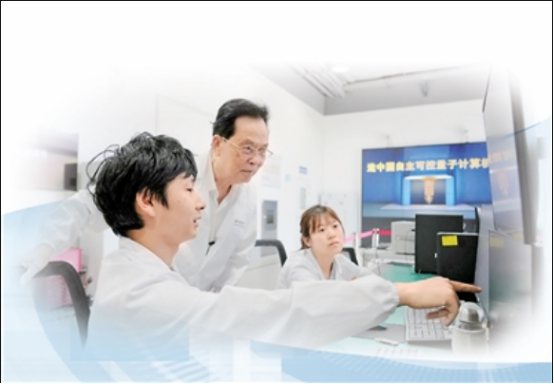
At 7:30 a.m., on the campus of the University of Science and Technology of China (USTC), CAS Academician Guo Guangcan hurries toward the Key Laboratory of Quantum Information, Chinese Academy of Sciences. Inside this unassuming small building, research teams specializing in quantum cryptography and quantum devices, semiconductor quantum chips, and quantum entanglement networks converge—here, breakthroughs like the principles of quantum error-avoiding coding and quantum probabilistic cloning were born.
From introducing the theoretical system of quantum optics to China in the 1980s, to pioneering quantum information science research in the country in the 1990s, and later dedicating himself to developing China’s independently usable quantum computers, Guo has spent over 40 years immersed in the field of quantum science.
“We must develop our own quantum optics research”
Quantum optics is a cutting-edge discipline studying the quantum properties of light fields and their interaction with matter. It reveals that light not only has a wave nature but is also composed of discrete photons. Exploring quantum states of light (such as coherent states and squeezed states) and non-classical phenomena like quantum entanglement can drive breakthroughs in technologies such as quantum communication, quantum computing, and ultra-precise measurement.
In the early 1980s, quantum optics research had been advancing internationally for over 20 years, but it remained a blank slate in China. In 1981, 39-year-old Guo, one of the first government-sponsored scholars after China’s reform and opening-up, traveled to Canada to study. There, he encountered cutting-edge quantum optics research and made a silent vow: “We must develop our own quantum optics research.”
Guo was born into a fisherman's family in Fujian. Despite poverty, his mother insisted on sending all three children to school. In 1960, Guo enrolled in USTC’s Department of Radio Electronics. “I wanted to study semiconductors, so I applied to USTC’s Radio Electronics Department. Later, I learned the semiconductor major was in the Physics Department, not Radio Electronics,”Guo recalled. “But this twist of fate led me to USTC’s newly established gas laser program in the Radio Electronics Department. I was fascinated by this field, and thus began my connection with optics.”
After returning from his studies abroad, with USTC’s support, Guo hosted China’s first quantum optics academic conference in 1984 at Langya Mountain in Chuzhou, Anhui. “Even though many concepts were still unclear to everyone, a consensus emerged: this conference should continue,” Guo said.
Over the next 40 years, the Quantum Optics Academic Conference was held every two years without interruption. “The first conference in 1984 drew just a few dozen participants; by the 21st conference in 2024, over 800 people attended—quantum optics has gained far more attention,” Guo noted.
As interest grew, Guo turned his focus to better cultivating talent in quantum optics. He launched China’s first quantum optics course, and his lecture notes were published as a collection in 1991. Many researchers first learned about quantum optics through his course and notes, going on to become backbone figures in quantum research.
“Our achievements today are inseparable from the country’s support over 20 years ago”
With China’s quantum optics research lagging 20 years behind the international cutting edge, Guo Guangcan was always looking for a research direction with greater breakthrough potential. In the early 1990s, while reading academic papers, he came across the term “quantum information”—a newly proposed field in international academia—and keenly recognized its immense value.
Quantum information is an emerging interdisciplinary field that processes and transmits information based on quantum mechanical principles such as superposition and entanglement. At its core is the use of quantum bits (qubits) as information units, aiming to break the limits of classical information technology. It primarily encompasses three key areas: quantum computing, quantum communication, and quantum precision measurement.
The fundamental theories of quantum information are precisely the quantum optics fundamentals Guo had studied earlier. Its innovation lies in systematically introducing quantum theory into the field of information, thereby giving classical concepts like computing and cryptography brand-new quantum interpretations. When information is quantized, its performance far surpasses that of classical information, boasting enormous potential applications and breathing new life into quantum optics.
Guo proposed to several research institutions the idea of conducting quantum information research, but his suggestions were met with indifference. Some even questioned, “We haven’t fully grasped traditional classical information—why bother with quantum information?” or “Is this even real science?”
Faced with such misunderstandings and setbacks, Guo remained undaunted. He realized that to change the situation, he first needed to popularize the concept of quantum information. To this end, he published a series of articles in leading academic journals, sparking interest among some domestic scholars.
In 1998, at the Xiangshan Science Conference initiated by the Ministry of Science and Technology (formerly the State Science and Technology Commission), Guo’s proposal on “quantum communication and quantum computing” became one of the key themes. Wang Daheng, chair of the conference and recipient of the “Two Bombs and One Satellite Merit Medal,” stated at the meeting: “Quantum science is crucial—China must have a voice in this field.”
In 1999, with support from the Chinese Academy of Sciences, Guo established the Open Laboratory of Quantum Communication and Quantum Computing at USTC. It later upgraded to the Key Laboratory of Quantum Information, Chinese Academy of Sciences—the first provincial-ministerial key laboratory in China’s quantum information field.
In 2001, Guo secured the first “973 Program” project in the quantum information field. He then assembled a team of over 50 researchers from more than 10 domestic institutes and universities, covering fields such as quantum cryptography, quantum computing, quantum communication, and quantum networks. Over five years, they not only produced a wealth of research results but also nurtured a team of innovative researchers.
“This marked a turning point for China’s quantum information research—from ‘0 to 1’ to ‘1 to 100’,” Guo said. “Our achievements today are inseparable from the country’s support over 20 years ago.”
“Quantum computer research isn’t a task for a single generation—we need to let young people get involved early”
In 2011, Guo Guangcan’s team took on the Ministry of Science and Technology’s “Solid-State Quantum Chip” project, tasked with developing China’s own quantum chips. While many hoped Guo himself would serve as chief scientist, he insisted that Guo Guoping, then a USTC professor under 35, take the role.
A quantum chip is akin to the “brain” of future quantum computers, its significance self-evident. “Quantum computer research isn’t a task that can be accomplished by a single generation,” Guo Guangcan said. “Letting young people get involved early means they can move faster and achieve more.”
Guo Guoping lived up to expectations. In 2013, he led his team to successfully implement 10-picosecond-level quantum logic gate operations on “a single electron,” breaking the previous world record by nearly 100 times—a crucial step toward making quantum computing practical.
In 2017, Guo Guangcan and Guo Guoping, together with their team from the Key Laboratory of Quantum Information, CAS, co-founded China’s first quantum computing company: Origin Quantum Computing Technology (Hefei) Co., Ltd. Their goal was to develop an engineered quantum computer that users could interact with, ensuring China has independent and controllable quantum computing capabilities.
Building on Origin Quantum, Guo Guangcan and Guo Guoping accelerated the commercialization of the laboratory’s quantum computing research, rolling out three generations of self-developed superconducting quantum computers. To date, China’s third-generation self-developed superconducting quantum computer, “Benyuan Wukong,” has been accessed by users from 139 countries and regions over 25 million times, completing more than 380,000 global quantum computing tasks spanning fields like fluid dynamics, finance, and biomedicine.
Now in his 80s, Guo Guangcan remains active in educating the next generation. He gives popular science lectures to middle school students and has participated multiple times in the “Sinan Cup” Quantum Computing Programming Challenge. Over three editions, the competition has attracted more than 5,000 university students, cultivating new talent reserves for China’s quantum computing endeavors.
“All my life, I’ve wanted to strive to do one thing well, cultivate a group of talents, and fulfill my responsibilities,” Guo said. “I hope young people will take the baton and work together to drive quantum computing technology toward industrialization.”
Extended Reading
What technical challenges must be overcome to develop a quantum computer?
Developing a quantum computer is a complex task. Take the superconducting quantum computer as an example: it mainly consists of quantum chips, quantum computing measurement and control systems, cryogenic environment support systems, as well as quantum computer operating systems and application software.
As the "heart" of a quantum computer, the quantum chip is responsible for executing key computational acceleration processes. This process requires converting problems into quantum algorithms, inputting them into the quantum chip via special modulated pulse signals, and finally collecting and analyzing the output signals from the chip to derive solutions. For the quantum chip to operate efficiently, a robust hardware system is essential, including quantum chip packaging technology, quantum chip testing platforms, quantum measurement and control systems, and related components.
The quantum chip testing platform, composed of cryogenic dilution refrigerators and supporting facilities, provides the quantum chip with highly isolated operating conditions such as a cryogenic environment, shielding from infrared radiation noise and magnetic field noise, and minimal mechanical vibration. It also requires high-efficiency heat-conducting components to promptly dissipate heat generated during the chip’s operation.
The quantum computing measurement and control system handles the generation, acquisition, control, and processing of all signals required by the quantum chip. Acting like a "translator," it converts complex human problems into a "language" understandable by the quantum chip and guides it to perform efficient computations.
Meanwhile, a quantum computer requires a complete software system to support its operation, including a quantum computer operating system, quantum language compiler, quantum application software, and quantum computer integrated development environment (IDE). These software systems not only provide users with programming and operation interfaces for quantum programs but also interface with hardware, converting programs into instruction signals required by the hardware to ensure the quantum computer can execute various computational tasks efficiently and accurately.
 Lead the Intelligent Welding Revolution: Greater Bay Area AI + Laser Welding Summit
 Splashing 200 Million Yuan! Three Industry Giants Boost Investment in the Laser Track
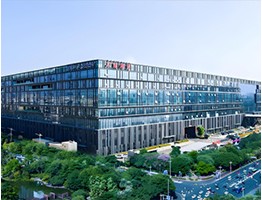 Two New Companies Established! Han's Ecosystem Further Expands
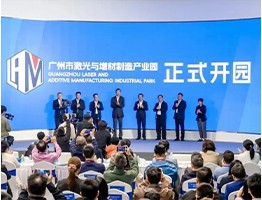 Multi-Sector Flourish! Five Major Laser Parks Rise Rapidly
 The Grand Finale is Here! Three Major Laser Headquarters Base Projects Topped Out
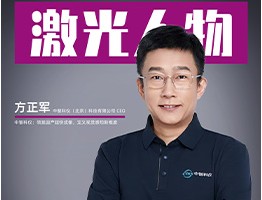 Intelligent Scientific Systems: Leading Domestic Ultrafast Imaging, Redefining Visual Perception
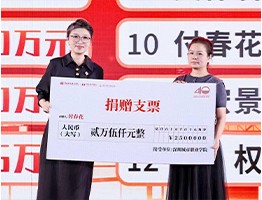 From Rural Girl to Laser Helmsman: Fu Chunhua's Light-Chasing Journey
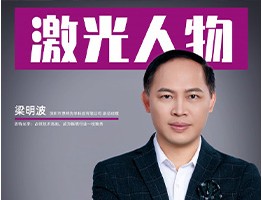 Scanner Optics: Galvanometer Tech Leader
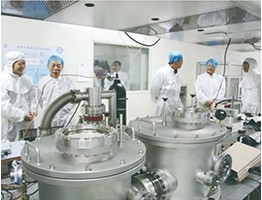 The "Light Chasers" in the Deep Ultraviolet World
 Shi Lei (Hipa Tech): Focus on Domestic Substitution, Future Layout in High-End Laser Micromachining