
From the Moon to the Stars: How Lasers Are Rewriting the "Speed and Passion" of Deep Space
source:Futing Quantum Technology
keywords:
Time:2025-09-17
Source: Futing Quantum Technology 29th Aug 2025
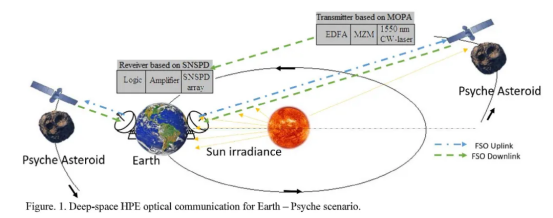
When NASA's "Psyche" probe sent back its first high-definition image from the orbit of an asteroid 270 million kilometers away, scientists on Earth held their breath. This 100-megapixel photo would have taken three months to transmit using traditional radio frequency communication, but through a laser link, it was completed in just four hours - this is not a scene from a science fiction movie, but a true portrayal of human deep space communication technology in 2025.
From the "laser express" between the Earth and the Moon to the interstellar data highway spanning 40 astronomical units (about 6 billion kilometers), deep-space optical communication is revolutionizing the way humans explore the universe. This article will take you into the cutting-edge laboratories of the European Space Agency (ESA) and NASA to reveal how lasers "run" in the near-vacuum of space and how scientists are breaking through physical limits to make the mysteries of distant planets "within reach" at the speed of light.
I. Why Does Interstellar Communication Require "Changing Lanes"?
From the RF Era to the Laser Revolution
In the first 60 years of human exploration of space, radio waves (radio frequency) were the "only link" connecting the Earth and spacecraft. From lunar probes to Mars rovers, RF signals in the X-band (8-12 GHz) and Ka-band (26.5-40 GHz) have been like "space postmen", delivering data day after day. However, as deep space exploration enters the "high-definition era", this "old postman" is becoming increasingly inadequate.
Take the European Space Agency's "Jupiter Icy Moons Explorer" (JUICE) as an example. It has only an 8-hour communication window each day and can transmit back a maximum of 1.4 GB of data - equivalent to the capacity of a high-definition movie. Meanwhile, NASA's Mars Reconnaissance Orbiter (MRO) has a maximum data rate of only 5.2 Mbps, which is not even sufficient for smooth playback of short videos. If a manned mission to Mars is carried out in the future, the existing radio frequency technology will simply be unable to meet the demand for astronauts to have video calls with Earth.
The problem lies in the "inherent insufficiency" of the radio frequency spectrum. Just like the limited lanes on a highway, the radio frequency band is already overcrowded, and its information capacity (bandwidth) is restricted by physical laws, making it difficult to break through. What's more troublesome is that signals in deep space transmission will attenuate with the square of the distance: when the probe flies to 10 astronomical units (about 1.5 billion kilometers) away, the intensity of the radio frequency signal will attenuate to one ten-thousandth of the original, just like listening to the sound of a needle dropping on the ground from a distance in a noisy stadium.
At this point, laser communication stepped forward. As the "messenger of light", the 1550 nm wavelength laser has a frequency as high as 193 THz, meaning that its information-carrying capacity is 10 to 100 times that of radio frequency - equivalent to widening a country road into a multi-lane highway.
II. The "Laser Test Field" Between the Earth and the Moon
— How does LLCD demonstrate rewriting the rules of communication?
In 2013, a spacecraft named "Lunar Atmosphere and Dust Environment Explorer" (LADEE) entered the lunar orbit. It carried the "Lunar Laser Communication Terminal" (LLST), initiating the first-ever two-way laser communication experiment between Earth and the Moon, known as LLCD (Lunar Laser Communications Demonstration).
At that time, NASA established a link with LADEE from its ground station in New Mexico, while ESA deployed its own "Lunar Laser Optical Ground System" (LLOGS) at the "Teide Observatory" (OT) on Tenerife Island, Spain. This system acts like a "super flashlight", sending laser signals to the moon through a 1-meter aperture Cassegrain telescope and simultaneously receiving responses from the spacecraft.
To avoid interference between the transmitter and the receiver, scientists have designed a "dual-base" architecture: three 40-millimeter transmitting apertures are arranged around the receiving aperture, just like "inlaying" three small lasers around a telescope. This layout ensures that the transmitted and received signals do not "clash".
The test results were astonishing: LADEE's downlink rate (from the moon to the Earth) reached 622 Mbps, which was over 300 times that of the X-band radio frequency communication at that time; the uplink rate (from the Earth to the moon) also reached 20 Mbps, sufficient for real-time command transmission. The laser signal completed the round trip over a distance of 400,000 kilometers in just 1.3 seconds.
The key to success lies in the superconducting nanowire single-photon detector (SNSPD). Traditional avalanche photodiodes (APDs) have low detection efficiency and are prone to noise interference, just like taking pictures of stars with a regular camera on a rainy day, almost nothing can be seen. However, SNSPD can precisely identify individual photons, with a detection efficiency of over 90%. During the experiment, the European Space Agency (ESA) also tested the photomultiplier tube (PMT) from Hamamatsu, Japan, but the results were significantly different: at a wavelength of 1550 nm, the quantum efficiency of PMT was less than 6%, and there was a dark count of 200 kHz (false detection), ultimately achieving only a rate of 38 Mbps. This convinced scientists that SNSPD is the "standard equipment" for deep space optical communication.
The LLCD demonstration also established the "High Efficiency Photonics" (HPE) communication standard. This set of rules, formulated by the Consultative Committee for Space Data Systems (CCSDS), acts as the "international common language" for deep space communication, specifying coding methods (such as serial concatenated convolutional coding pulse position modulation, SCPPM), modulation techniques (intensity modulation/direct detection, IM/DD), etc., ensuring that equipment from different countries can "understand" each other's signals.
III. "Laser Pioneers" Bound for Asteroids
How does the DSOC project challenge 2.7 astronomical units?
In October 2023, NASA's "Psyche" probe was launched into space, with the mission to reach the "16 Psyche" asteroid located between Mars and Jupiter. It carries the "Deep Space Optical Communications" (DSOC) payload, which is conducting the most ambitious optical communication experiment in human history - establishing an end-to-end efficient photon communication link at a distance of up to 2.7 astronomical units (approximately 400 million kilometers).
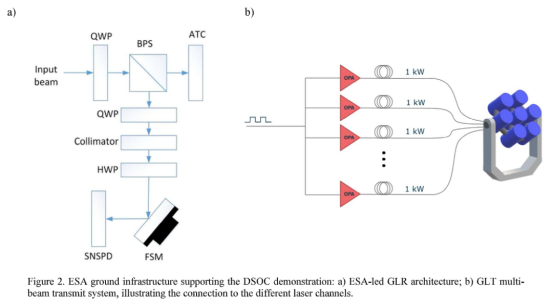
ESA set up the ground stage for this experiment: in the Peloponnese Peninsula of Greece, two observatories were transformed into "outposts" for laser communication - the Helmos Observatory was equipped with a "Ground Laser Receiver" (GLR), and the Kryoneri Observatory was equipped with a "Ground Laser Transmitter" (GLT). The two locations are 37 kilometers apart, forming a "non-collocated bistatic" architecture.
The "reception manual" of GLR: It is installed on the "Aristarchus Telescope" at the Helmos Observatory. This telescope has a diameter of 2.28 meters and can collect extremely weak laser signals. After the signal enters the telescope, it first passes through a quarter-wave plate (QWP) and a polarizing beam splitter (PBS), splitting the light signal into two beams: one enters the InGaAs camera for aiming and tracking, while the other is sent to the SNSPD array for data reception.
The core of the SNSPD array is the meander-shaped superconducting nanowire. only when the polarization direction of the incident light is parallel to the nanowire can the highest detection efficiency be achieved. For this reason, scientists have installed a half-wave plate (HWP) to adjust the polarization direction, just like adjusting the posture of the signal to ensure it can be "caught" by the nanowire.
To address the beam jitter caused by atmospheric turbulence, GLR does not employ a complex adaptive optics (AO) system (which would waste precious photons), but instead uses a "fast steering mirror" (FSM) and a four-quadrant SNSPD for real-time correction. The FSM can adjust the angle at the microsecond level, stabilizing the spot on a 60 μm x 60 μm SNSPD array.
GLT's "ace in the hole": It consists of a "laser array" of seven 1 kW lasers, with a total power of 7 kW. These lasers emit at a wavelength of 1064.1 nm and are modulated with a square wave pulse at 3.8147 kHz. They can serve as "beacons" to assist spacecraft in positioning and also carry command data.
Seven laser beams are designed to be "incoherently combined", with each beam having a divergence angle of 20 micro-radians. This way, at the farthest distance of 2.7 astronomical units, the spot diameter can still be kept within a reasonable range, ensuring that the spacecraft can receive at least 4 pW/m2 of power.
IV. Laser vs. Radio Frequency:
Who is the ultimate winner in deep space communication?
On the "track" of deep space communication, the competition between lasers and radio frequencies has never ceased. By comparing their key parameters and performance, we can more clearly see the advantages and limitations of lasers.
Core Parameter Showdown
In terms of hardware specifications, the "figure" of the laser system is more compact: the laser emission aperture of the "Psyche" probe is only 0.22 meters, while the diameter of the Ka-band radio frequency transmitting antenna is 3 meters; the average laser transmission power is 4 W, much lower than the 35 W of the Ka-band, thus saving more energy for the spacecraft.
The ground equipment of the laser system features "substituting precision for size": its receiving telescope has an aperture of only 2.28 meters, far smaller than the 34-meter giant antenna of the Ka band, but it must be equipped with a key device, the superconducting nanowire single-photon detector (SNSPD). After more than a decade of commercial development, SNSPD has been verified for stability and reliability in fields such as quantum communication and lidar, becoming a mature technical cornerstone supporting deep-space optical communication. In contrast, the traditional microwave antenna relied on for radio frequency reception, although technologically mature and easy to deploy, is limited by physical bottlenecks of bandwidth and power efficiency, and the transmission capability gap with the laser system has formed a generational chasm.
The "watershed" of transmission performance
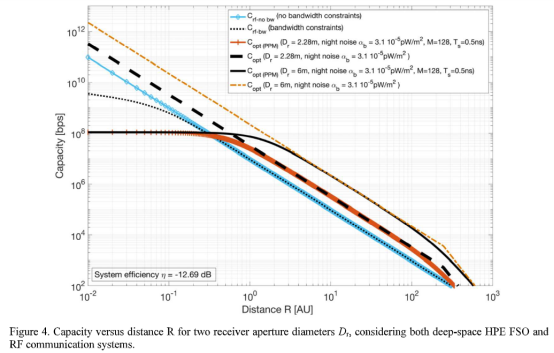
In terms of information capacity (i.e., the amount of data that can be transmitted), the advantage of lasers over Ka-band varies with distance, showing a pattern of "initially rising then falling". When the distance is relatively short (e.g., less than 10 astronomical units), the capacity of laser communication far exceeds that of Ka-band: at 2.5 astronomical units, the theoretical capacity of a laser link is over 100 times that of Ka-band. This is because the bandwidth of lasers is nearly unlimited (the near-infrared band can provide several GHz of bandwidth), while the bandwidth of Ka-band is limited to 500 MHz.
However, when the distance exceeds a certain critical point (R*), the capacity of the laser will suddenly change from being inversely proportional to the square of the distance (1/R2) to being inversely proportional to the fourth power of the distance (1/R?), with a much faster attenuation rate than that of the Ka band (which remains at 1/R2). This is because at extremely long distances, there are too few laser photons, and the signal-to-noise ratio drops sharply, just like having too few "messengers" to convey the information completely. Scientists have found through simulations that this critical point R is approximately 100 astronomical units.
Real Challenge: More Than Just Distance
In addition to attenuation, lasers also face the "aiming challenge". At a distance of 2.7 astronomical units, even if the aiming error at the transmitting end is only 0.1 arcsecond (equivalent to seeing a coin on the moon from the Earth), the beam will deviate from the receiving end by tens of thousands of kilometers. Therefore, the DSOC payload of "Psyche" needs to use the "Predictive Aiming Angle" (PAA) technology to calculate the aiming direction in advance based on the movement of the spacecraft and the Earth.
The influence of the atmosphere should not be underestimated either. When the laser passes through the atmosphere, turbulence makes the beam "dance", causing fluctuations in signal strength (i.e., "atmospheric scintillation"); clouds and fog can even directly "swallow" the laser - this is also the reason why GLT and GLR are located in the mountainous areas of Greece (with many sunny days and stable atmosphere). In contrast, Ka-band radio frequency signals are much less affected by weather and can be called "all-weather communicators".
V. The Picture of Interstellar Communication in 2050
From Giant Planets to Interstellar Probes
As the "Cosmic Vision" program comes to an end, ESA is mapping out the blueprint for space exploration in the next decade - "Voyage 2050". One of the core goals of this plan is to establish a deep-space optical communication network covering the giant planets (Jupiter, Saturn, Uranus, and Neptune) beyond 4.2 astronomical units.
To achieve this goal, laser technology needs to take another leap forward. Take Jupiter as an example. It is about 5.2 astronomical units away from the Earth, and the laser signal takes 48 minutes for a one-way trip. To achieve a data rate of 10Mbps at this distance, the receiving telescope's aperture needs to be expanded to more than 6 meters, and the dark count rate of the SNSPD needs to be reduced to below 100Hz.
In the more distant future, humans may launch probes to planets outside the solar system (such as those 5 to 15 light years away). At this point, laser communication will face its "ultimate test": over distances of several light years, it takes years for a single photon to travel from emission to reception, and the probability of it reaching Earth is extremely low.
NASA's research shows that to achieve a communication rate of 1 kbps at a distance of 10 light years, a transmission power of several kilowatts is required, along with a receiving telescope with a diameter of over 100 meters (equivalent to the size of a football field). Additionally, "laser relay satellites" need to be deployed in space to act as "signal gas stations" and help forward data for the probes.
Conclusion:
The technological revolution that enables the universe to "speak"
From the Earth-Moon laser link of LADEE to the asteroid communication experiment of "Psyche", and then to the giant planet exploration in the "Voyage 2050" plan, deep space optical communication is rewriting the way humans communicate with the universe. It is not only a technological breakthrough but also a "revolution in thinking" - making us realize that in the vast universe, the transmission of information is as important as exploration itself.
Paper link:
https://www.spiedigitallibrary.org/conference-proceedings-of-spie/13699/136991J/Deep-space-optical-communications-challenges-and-technological-advancement/10.1117/12.3075403.full
 Lead the Intelligent Welding Revolution: Greater Bay Area AI + Laser Welding Summit
 Splashing 200 Million Yuan! Three Industry Giants Boost Investment in the Laser Track
 Two New Companies Established! Han's Ecosystem Further Expands
 Multi-Sector Flourish! Five Major Laser Parks Rise Rapidly
 The Grand Finale is Here! Three Major Laser Headquarters Base Projects Topped Out
 Intelligent Scientific Systems: Leading Domestic Ultrafast Imaging, Redefining Visual Perception
 From Rural Girl to Laser Helmsman: Fu Chunhua's Light-Chasing Journey
 Scanner Optics: Galvanometer Tech Leader
 The "Light Chasers" in the Deep Ultraviolet World
 Shi Lei (Hipa Tech): Focus on Domestic Substitution, Future Layout in High-End Laser Micromachining