LIVINGSTON, La., HANFORD, Wash. and CASCINA, Italy, Oct. 17, 2017 — Scientists from the international LIGO and Virgo Scientific Collaborations have announced the detection of the bright spark of two neutron stars colliding. This event has been dubbed GW170817 because it sent ripples through space-time that reached Earth on August 17, 2017. GW170817 lasted more than a minute and a half and is the first ever detection of light from a gravitational wave source. Ultimately, about 70 observatories on the ground and in space observed the event on August 17 at their representative wavelengths.
Comprising three enormous laser interferometers located in the United States and Italy, the LIGO and Virgo detectors work together to detect and understand the origins of gravitational waves. The waves detected in August came from the violent merger of two neutron stars believed to have formed roughly 11 billion years ago.
 Artist Robin Dienel’s concept of the explosive collision of two neutron stars. This material relates to a paper that appeared in the Oct. 16, 2017, online issue of Science, by D.A. Coulter at University of California, Santa Cruz and colleagues. Courtesy of the Carnegie Institution for Science.
As these neutron stars spiraled together, they emitted gravitational waves that were detectable for about
100 seconds; when they collided, a flash of light in the form of gamma rays was emitted and seen on Earth about two seconds after the gravitational waves. In the following days and weeks, other forms of light were detected.
Previous detections of gravitational waves have all involved the merger of two black holes, a feat that won the 2017 Nobel Prize in Physics earlier this month. However, black hole mergers are not expected to produce any electromagnetic radiation, meaning they cannot be detected by conventional telescopes. In contrast, binary neutron star (NS-NS) mergers have long been expected to produce an energetic explosion and a plume of radioactive material, generating light, but have never previously been detected.
Several papers describe how light from the neutron star merger was precisely located; discuss subsequent observations at x-ray, UV, optical, IR and radio wavelengths; and offer theoretical analysis of the event.
A study by David Coulter et al. describes how a team of astronomers pinpointed the location of the merger during the critical few hours following detection of the gravitational waves. The team used the Swope 1-m telescope in Chile to search for light emitted by the merger, searching the area of the sky that the gravitational waves could have come from. Using a catalog of known nearby galaxies, they created a prioritized list of likely locations and began snapping images of them. In just their ninth image, the researchers spotted a new source and identified the location of the event: within a galaxy called NGC 4993, about 130 million light years away. As the first team to locate the source, they dubbed it Swope Supernova Survey 2017a (SSS17a).
Immediately after SSS17a was identified, Maria Drout and colleagues began monitoring its brightness with the Swope and Magellan telescopes. Combining their observations with data from other facilities, they analyzed the UV, optical and IR brightness of the event from 11 hours to 18 days after the merger. The source quickly faded and changed from a blue to a red color — a sign that the material was expanding rapidly and cooling as it went. They interpret the emission as a “kilonova,” an ejection of newly-produced heavy elements whose radioactive decay powers the emission of UV, optical and IR light. They estimate that the merger ejected material with a mass of 5 percent of our sun, containing heavy chemical elements such as lanthanides.
A separate study by Phil Evans et al. described how the Swift and NuSTAR space telescopes were used to observe the event at UV and x-ray wavelengths. The Swift satellite quickly detected a UV source at the location of the event, but it rapidly faded and had disappeared two days later. The UV observations imply that material was ejected at a velocity that is a substantial fraction of the speed of light, and that it was hotter at early times than theoretical models of kilonova had predicted.
Benjamin Shappee et al. studied the optical and NIR spectrum emitted by SSS17a between 12 hours and 18 days after the merger. They show that it behaves unlike any previously-known class of astronomical transient, such as supernovae or gamma-ray bursts. Their earliest observations show that the material ejected from the merging neutron stars was expanding at about 30 percent of the speed of light, much faster than a supernova. As the material expands and cools, the spectrum becomes more complicated. They concluded that the ejecta contain two different components: one hot, blue and short-lived, while the other is cooler, redder and produces light for longer. There are no absorption lines due to the host galaxy in the spectrum. They noted that no single previously existing model can fully explain the spectroscopic changes they observed.
Gregg Hallinan, Alessandra Corsi and colleagues monitored the event using numerous radio telescopes around the world. Sixteen days after the gravitational waves reached Earth, they detected the first radio waves from the event. The lack of radio emission at earlier times indicates that the relativistic jet, required to produce the observed gamma rays, cannot be aligned with the line of sight to Earth. They produced two different models that can explain the radio brightness while being consistent with observations at other wavelengths, and showed how the two models make different predictions for how the radio emission will change over the next few months.
A study by Charles Kilpatrick et al. combined optical to NIR brightness and spectroscopy data with modeling, to determine the nature of the event independently of the gravitational wave signal. The observations of SSS17a match what scientists have previously predicted for kilonova events, but only if there are two distinct components with different masses, velocities and fractions of lanthanide elements. These properties indicate that at least one of the merging objects must have been a neutron star, and the other one probably was too, thereby confirming the result found from the gravitational waves. They also calculate the amount of heavy elements produced in the SSS17a merger, estimate how frequently those events occur, and show that NS-NS mergers can be a major source of the lanthanide elements throughout the Universe, including those on Earth.
A paper by Mansi Kasliwal and colleagues brings together observations at x-ray, UV, optical, IR and radio wavelengths to produce a detailed theoretical model of the merger. Using data from 24 telescopes on seven continents, they reconstructed the total energy emitted by the event at each stage, then sought to simultaneously explain the observations at all wavelengths. In their preferred model, a jet of material is produced that expands at close to the speed of light, but is directed away from their line of sight. Instead, they saw emission from a “cocoon” of shocked material surrounding the jet, which expands over a wider angle. They confirmed this model with detailed simulations, and predicted that about 30 percent of future NS-NS mergers will produce bright gamma rays that will reach Earth. Finally, they estimated the mass of heavy elements produced in the event and use that to calculate the rate of NS-NS mergers, showing that neutron star mergers can be a major source of those elements and that many more detections can be expected.

 Lead the Intelligent Welding Revolution: Greater Bay Area AI + Laser Welding Summit
 Splashing 200 Million Yuan! Three Industry Giants Boost Investment in the Laser Track
 Two New Companies Established! Han's Ecosystem Further Expands
 Multi-Sector Flourish! Five Major Laser Parks Rise Rapidly
 The Grand Finale is Here! Three Major Laser Headquarters Base Projects Topped Out
 Intelligent Scientific Systems: Leading Domestic Ultrafast Imaging, Redefining Visual Perception
 From Rural Girl to Laser Helmsman: Fu Chunhua's Light-Chasing Journey
 Scanner Optics: Galvanometer Tech Leader
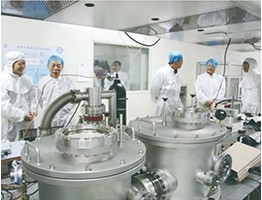 The "Light Chasers" in the Deep Ultraviolet World
 Shi Lei (Hipa Tech): Focus on Domestic Substitution, Future Layout in High-End Laser Micromachining